
Centralized access management becomes difficult not because the idea is complex, but because real IT infrastructures are fragmented. Multiple authentication subsystems, isolated logs, legacy applications, and mixed access scenarios make centralization expensive and risky.
An access management platform should solve these problems without forcing organizations to deploy heavyweight Identity Governance and Administration (IGA) or Security Information and Event Management (SIEM) systems from day one.
Based on the real data migration challenges, here are five capabilities that truly matter in Access Management solutions.
1. A single authentication layer across disconnected systems
During migration to centralized access management, the biggest obstacle is rarely policy design. It’s heterogeneous authentication subsystems.
In a typical enterprise environment, different services — such as Active Directory, VPN gateways, remote desktop infrastructure, internal web applications, and legacy business systems — rely on separate user directories, different authentication mechanisms, and independent login flows that were never designed to work together.
As a result, users often need multiple accounts to access corporate resources.
Why this matters
Building a unified model through IGA alone requires:
- Extensive role modeling
- Long R&D cycles
- Deep changes to existing systems
For many organizations, this effort is unjustified when the immediate goal is simply to centralize authentication, not redesign identity governance.
What Axidian Access does
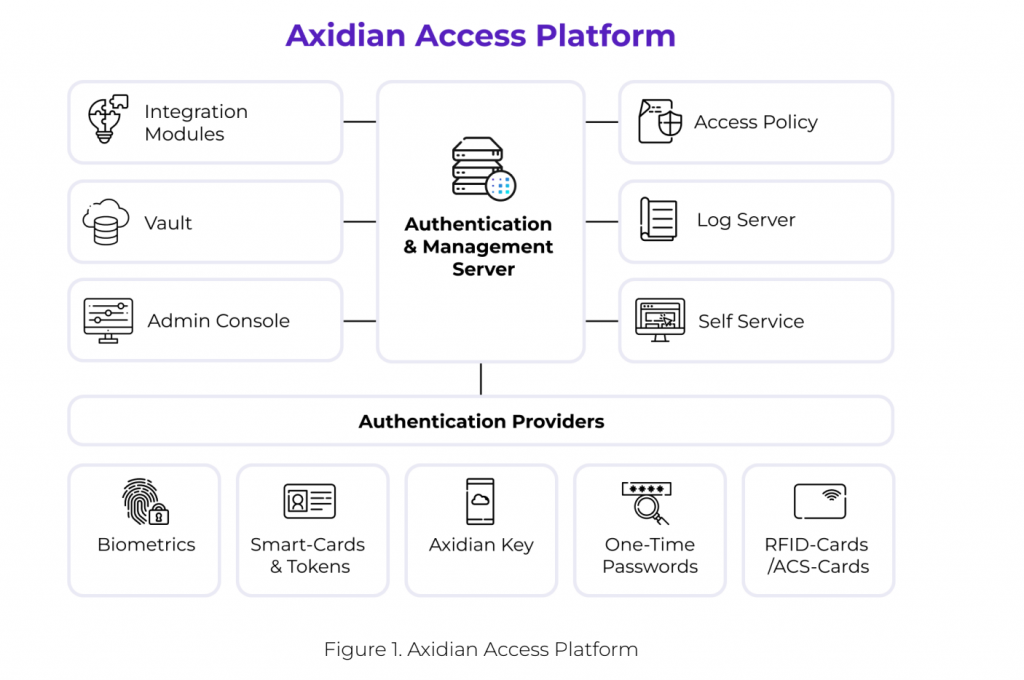
Axidian Access creates a single authentication system that is above existing services and applications. It does not replace user directories or permissions inside target systems. Instead, it unifies how users authenticate to them.
This approach allows organizations to:
- Keep existing identity structures
- Avoid complex IGA deployment
- Achieve centralized access control
2. One access event log instead of dozens of fragmented logs
Every service generates its own access log. Log formats vary, naming conventions are inconsistent, and timestamps are often difficult to correlate across systems.
When a security incident occurs, reconstructing the sequence of events often means manual review of:
- Active Directory logs
- VPN logs
- Application logs
- Remote access logs
Why this matters
Without a centralized view, incident investigation becomes slow and error-prone. Deploying SIEM can solve this but not every company has the budget, infrastructure, or team for it.
What Axidian Access does
Axidian Access maintains a single log of all access events with personalized connection data:
- Who authenticated
- To which system
- Using which authentication method
- And when
This log is sufficient for investigating access-related incidents on its own and can later be integrated with SIEM if needed. Axidian Access does not replace SIEM but it removes the immediate dependency on it.
3. Universal authentication policies across all target resources
Managing authentication separately for each system quickly becomes impractical because every change — from enabling MFA to updating authentication rules — has to be configured, tested, and maintained multiple times.
As the number of applications grows, this approach increases administrative effort, leads to inconsistent security controls, and makes it harder to guarantee that access policies are applied uniformly across the environment.
Why this matters
When policies are defined per system:
- MFA enforcement becomes inconsistent
- Changes require repetitive configuration
- Errors multiply as infrastructure grows
What Axidian Access does
Axidian Access allows administrators to define universal authentication policies once and apply them consistently across target resources.
After integrating a system:
- Authentication rules are inherited
- User groups are mapped once
- Ongoing administration is simplified
This reduces operational overhead expenses while keeping authentication control centralized and predictable.
4. Support for environments where passwords cannot be eliminated
In theory, replacing passwords sounds unchallenging. In practice, many services still support only password-based authentication.
Target resources may include:
- Windows workstations
- RDP servers
- VDI environments
- VPN gateways
- Legacy desktop applications
- Public web services
Why this matters
A platform that assumes passwordless support everywhere will fail during real deployment.
What Axidian Access does
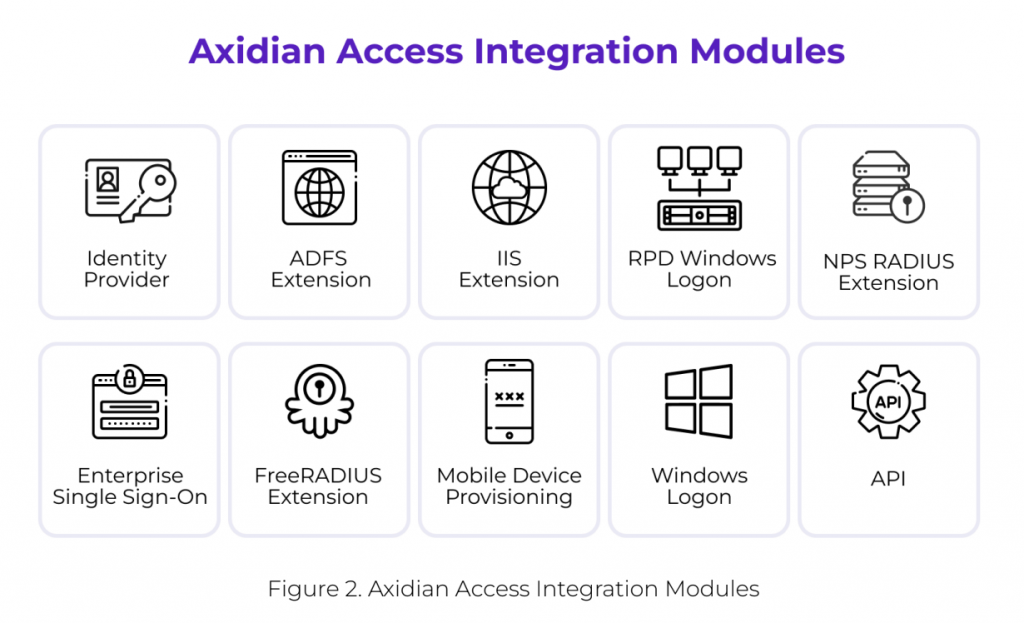
Axidian Access includes specialized integration modules that allow strong authentication even when passwords cannot be completely removed:
- Windows Logon and RDP Windows Logon for OS-level access
- Enterprise SSO for desktop and web applications
- IIS Extension, ADFS Extension, NPS RADIUS Extension for server-side integration
- SAML and OIDC Identity Providers for modern web applications
This ensures consistent access control across both modern and legacy systems.
5. A single set of authenticators for all access scenarios
Managing multiple authenticators for different systems can cause user confusion and create significant difficulties for administrators.
Why this matters
While using multiple authentication methods can strengthen security, it often creates friction for end users when those methods are applied inconsistently.
Employees are forced to remember which authentication flow applies to which system, leading to login errors, failed access attempts, and increased support requests.
Over time, this confusion discourages adoption and pushes users to look for workarounds — including reusing credentials or bypassing prescribed access paths, ultimately weakening the very security controls the organization is trying to enforce.
What Axidian Access does
Axidian Access allows organizations to define a single set of authenticators per user group, covering:
- Local access
- Remote access
- Internal and external systems
Authentication chains can combine:
- Biometrics
- One-time passwords
- Smart cards
- Push confirmations via a mobile app
This approach balances security requirements with usability and reduces authentication sprawl.
Choosing an access management platform
Centralized access management does not have to start with large-scale IGA or SIEM deployments.
Axidian Access focuses on the most immediate and practical challenge: unifying authentication and controlling access across a fragmented infrastructure with minimal effort and investment.
It does not compete with IGA or SIEM. It prepares the ground for them while delivering real security value today.