
What All Saudi Compliance Frameworks Agree On
Saudi cybersecurity compliance has become significantly more complex over the past decade. Since the launch of Vision 2030 in 2016, Saudi Arabia has been transforming its economy through cloud adoption, digital government services, AI, and connected infrastructure. As organizations become increasingly digital, cybersecurity naturally becomes more important — not only as a way to protect critical systems, but also as an essential part of doing business in a regulated environment.
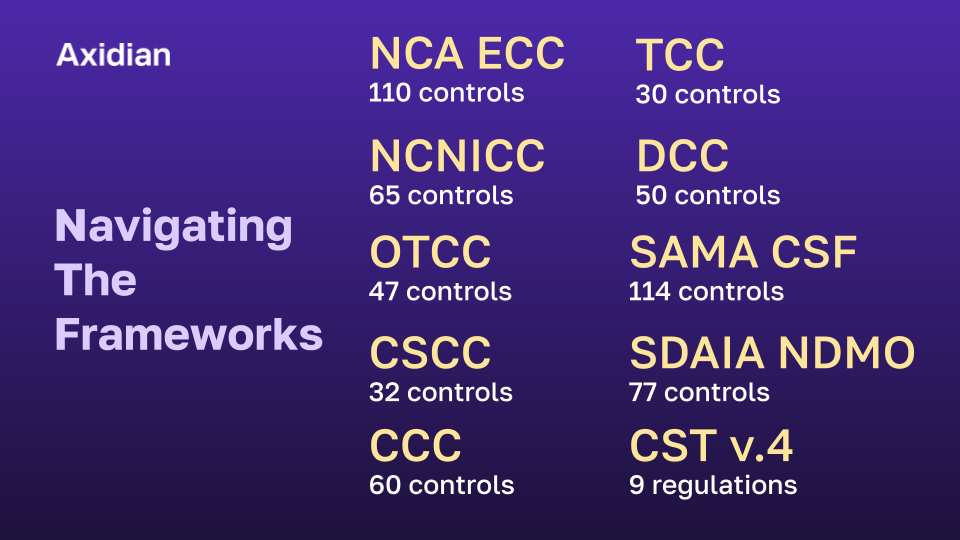
This transformation is clearly reflected in the Kingdom’s cybersecurity regulations. The National Cybersecurity Authority (NCA) was established in 2017 and introduced the Essential Cybersecurity Controls (ECC) in 2018.
Since then, additional frameworks have followed, covering cloud environments (CCC), critical systems (CSCC), operational technology (OTCC), telework (TCC), and data protection (DCC). Other regulators, including SAMA, CST, SDAIA, and sector-specific authorities, have also introduced their own cybersecurity requirements over the past several years.
This is a sign of a maturing cybersecurity ecosystem rather than increasing bureaucracy. As digital infrastructure becomes more complex, regulations naturally become more detailed and more specialized.
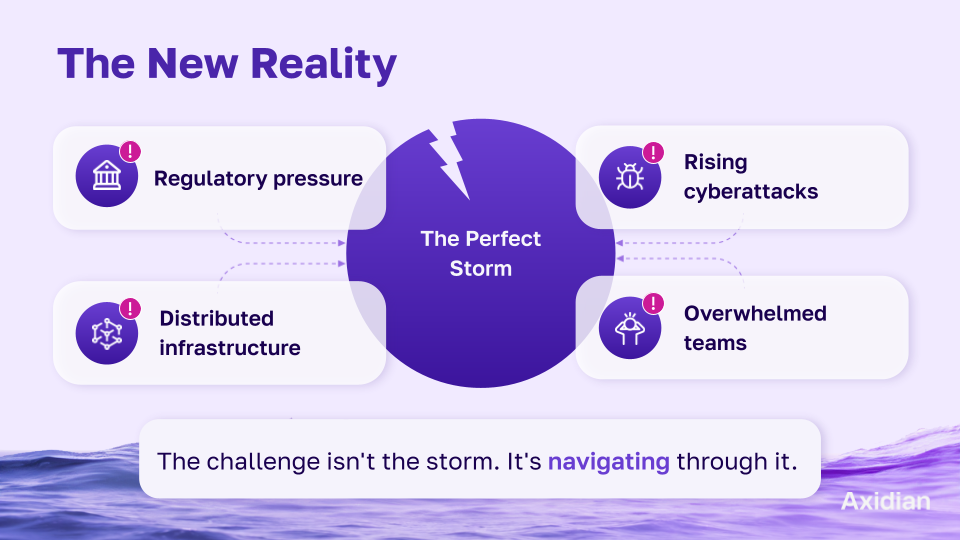
For security leaders, however, this evolution introduces a new challenge. Many organizations now need to comply with several frameworks simultaneously, each using different terminology, control structures, and documentation requirements. Taken together, Saudi cybersecurity regulations contain well over 500 individual controls, making it increasingly difficult to understand where to focus first. This realization changes the way organizations should approach Saudi cybersecurity compliance.
Different frameworks ask the same operational questions
Faced with this complexity, many organizations respond by treating every framework as a separate compliance project. Teams build new documentation, launch new initiatives, and prepare for each audit independently.
In practice, this often creates duplicated work, operational complexity, inconsistent implementation, and audit fatigue without significantly improving the organization’s overall security posture.
After mapping Saudi Arabia’s major cybersecurity frameworks side by side, one observation became impossible to ignore. While the documents differ in structure and terminology, they repeatedly evaluate the same operational capabilities.
Regardless of whether an organization is preparing for NCA ECC, SAMA CSF, CST regulations, or SDAIA requirements, auditors eventually ask very similar questions.
- Do you know which systems are critical?
- Do you know who has access to them?
- Can you detect suspicious activity?
- Can you recover after an incident?
- Can you demonstrate that your security controls actually work?
These questions go far beyond documentation. They measure how cybersecurity operates on a daily basis, how risks are managed, and whether security processes remain effective over time.
This realization changes the way organizations should approach compliance. Instead of building a new security program every time another framework appears, it is far more effective to strengthen the operational capabilities that support multiple regulations simultaneously.
Where should a CISO start?
Understanding that different compliance frameworks evaluate many of the same operational capabilities naturally leads to the next question: where should a security leader focus first?
Rather than approaching every regulation as a separate project, it makes more sense to prioritize the security capabilities that consistently appear across Saudi cybersecurity frameworks. Strengthening these foundations not only improves an organization’s security posture but also makes future compliance efforts significantly more manageable.
Secure the most critical access
The first priority should be protecting every critical access path. VPNs, privileged accounts, and cloud administration consoles should all be protected with multi-factor authentication, as compromised credentials remain one of the most common entry points for attackers.
At the same time, shared administrator accounts should be eliminated wherever possible. Privileged access needs to be controlled, monitored, and linked to individual users so that every administrative action can be traced back to a specific person.
Build visibility before incidents happen
Security teams cannot investigate what they cannot see.
Firewall logs, endpoint telemetry, cloud events, and server logs should be centralized into a SIEM so that suspicious activity can be detected and investigated quickly. Without centralized visibility, every incident takes longer to understand, increasing both response time and business impact.
Make resilience measurable
The next priority is resilience.
Having backups is not enough if no one knows whether they can successfully restore production systems under real operating conditions. The same principle applies to incident response. Organizations should regularly test their ability to respond to ransomware and other cyber incidents by involving security teams, IT operations, and business stakeholders rather than relying solely on documented procedures.
Maintain operational discipline
Beyond these priorities, organizations should maintain an accurate inventory of servers, endpoints, cloud workloads, and OT assets, regularly review third-party access, and prioritize remediation of internet-facing vulnerabilities before addressing lower-risk issues.
Equally important is maintaining governance processes. Policies, security baselines, risk assessments, and periodic access reviews may receive less attention than technical controls, but they provide the evidence that regulators expect to see during an audit. Consistently documenting and reviewing these activities throughout the year makes compliance far more predictable than preparing evidence shortly before an assessment.
Compliance follows capability
As Saudi Arabia continues its digital transformation, Saudi cybersecurity compliance will continue to evolve as new regulations and sector-specific requirements emerge. Organizations cannot avoid that complexity, but they can choose how they respond to it.
The most successful security teams will not be those that build the greatest number of compliance projects. They will be the ones that recognize the common operational foundations behind different frameworks and invest in capabilities that improve both security and compliance at the same time.
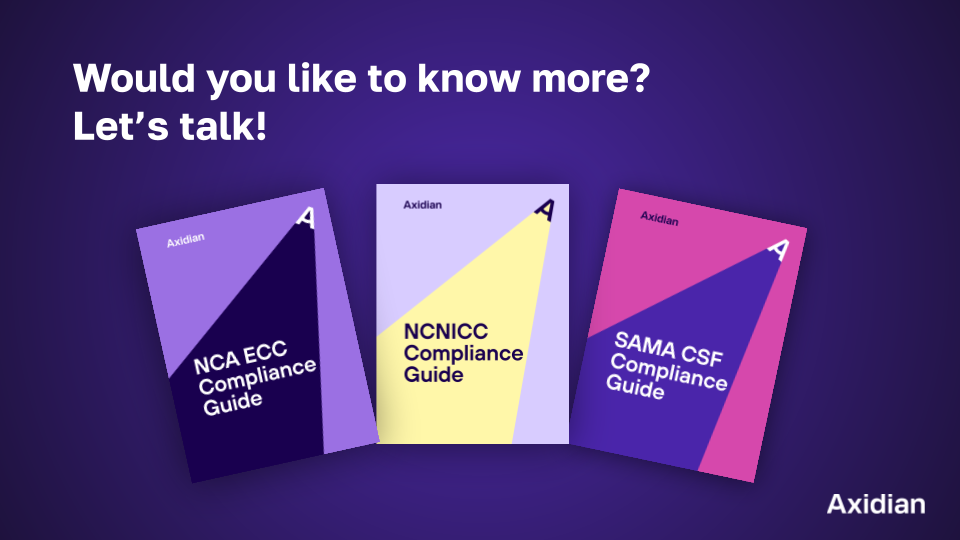
While this article focuses on the common principles shared across Saudi cybersecurity regulations, implementation always starts with understanding the requirements of a specific framework. If your organization is currently preparing for an assessment, our detailed guides on NCA Essential Cybersecurity Controls (ECC) and the SAMA Cybersecurity Framework (CSF) provide practical recommendations, implementation examples, and checklists to help security teams move from regulatory requirements to operational controls.